
Ni-NTA Agarose
Ni-NTA Agarose
Principle, Applications, and Protein Purification Guide
Introduction
Ni-NTA Agarose is a widely used affinity chromatography resin for the purification of recombinant proteins containing a polyhistidine tag (His-tag). It is commonly used in molecular biology, biotechnology, biochemistry, and structural biology laboratories to isolate target proteins from complex biological samples.
The technique is based on immobilized metal affinity chromatography (IMAC), which uses the interaction between nickel ions and histidine residues to selectively retain His-tagged proteins. Because of its relative simplicity and compatibility with different purification formats, Ni-NTA Agarose is an important tool in recombinant protein production and downstream processing.
Scientific literature describes Ni-NTA-based purification as a practical approach for isolating His-tagged proteins under both native and denaturing conditions, depending on the protein's characteristics and the intended application.
What Is Ni-NTA Agarose?
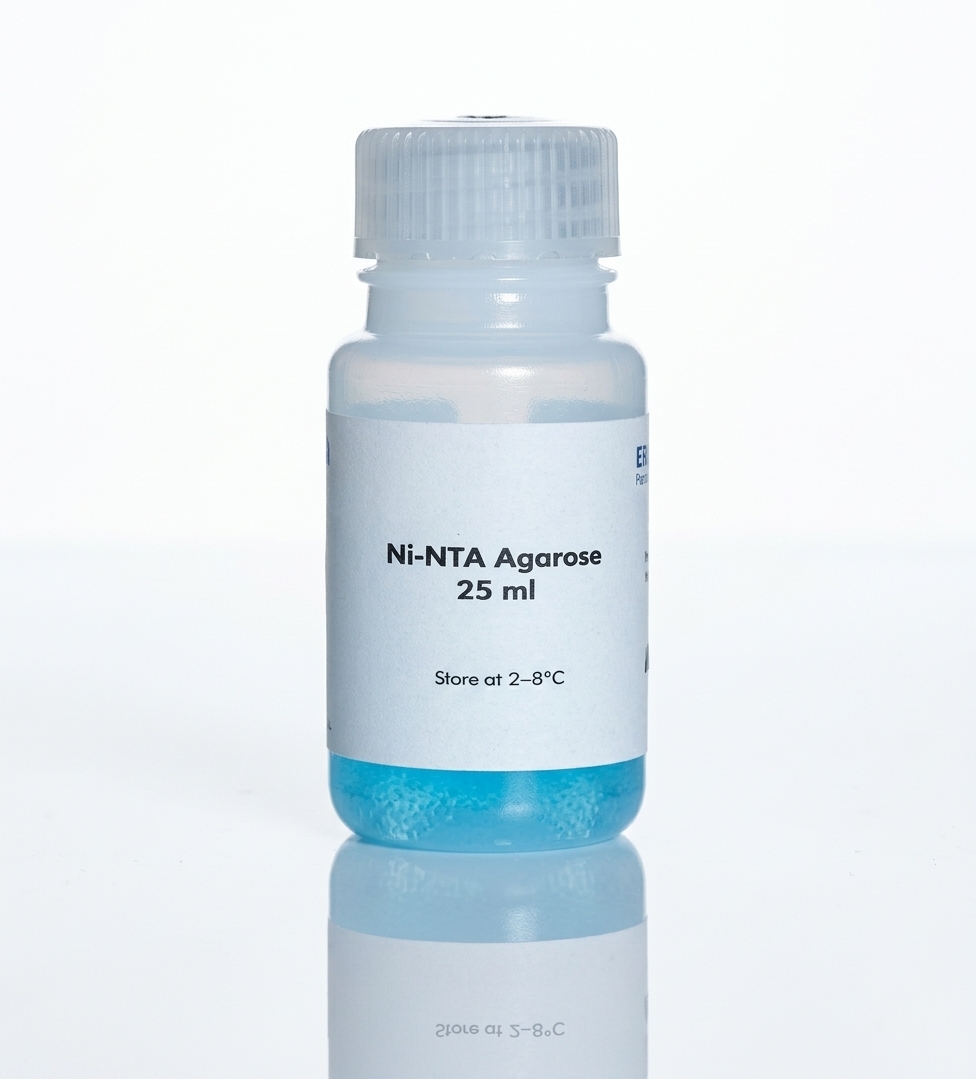
Ni-NTA Agarose is a chromatography matrix composed of agarose beads functionalized with nitrilotriacetic acid (NTA), a chelating molecule that coordinates nickel ions (Ni²⁺).
The immobilized nickel ions interact with histidine residues, particularly when several histidines are present close together in an engineered affinity tag. A commonly used tag is the hexahistidine tag, or 6×His-tag, which contains six consecutive histidine residues.
The agarose beads provide a porous solid support, allowing proteins to interact with the immobilized metal complexes during purification.
The main components are:
-
Agarose matrix: Provides the solid support for chromatography.
-
NTA ligand: Coordinates and retains nickel ions on the matrix.
-
Nickel ions (Ni²⁺): Interact with histidine residues in the target protein.
-
His-tagged protein: The recombinant protein selected for purification.
This combination enables the selective enrichment of tagged proteins from cell lysates and other protein-containing samples.
How Does Ni-NTA Agarose Work?
Ni-NTA Agarose purification generally follows four main stages: binding, washing, elution, and collection of the purified protein.
1. Sample preparation
The protein-containing sample is prepared by lysing cells or processing another biological material. The sample is clarified when necessary to remove insoluble debris.
The preparation conditions depend on the protein's solubility, stability, and accessibility of its His-tag.
2. Binding
The prepared sample is mixed with Ni-NTA Agarose or passed through a packed chromatography column.
The histidine residues in the His-tag coordinate with the immobilized nickel ions, allowing the target protein to bind to the resin.
3. Washing
The resin is washed with an appropriate buffer to remove unbound proteins and reduce nonspecific interactions.
Imidazole is frequently included at a low concentration in binding or washing buffers because it competes with histidine residues and can help reduce contamination by proteins that bind weakly to the resin.
4. Elution
The target protein is released from the resin by changing the buffer conditions. A common approach is to increase the imidazole concentration, which competes with the His-tag for interaction with nickel ions.
Alternatively, lowering the pH can weaken the interaction between histidine residues and the immobilized metal.
The collected fractions can then be analyzed to evaluate protein recovery, purity, and suitability for downstream experiments.
Main Applications of Ni-NTA Agarose
Purification of recombinant proteins
One of the principal applications of Ni-NTA Agarose is the purification of recombinant proteins expressed in bacterial, yeast, insect, or mammalian systems. The technique is especially useful when the protein has been engineered to contain a His-tag.
Enzyme purification
Researchers use Ni-NTA Agarose to enrich His-tagged enzymes for biochemical characterization, activity assays, and mechanistic studies. The purification conditions should preserve the enzyme's structural integrity and biological activity when functional measurements are required.
Structural biology
Protein samples intended for X-ray crystallography, cryo-electron microscopy, and other structural studies often require substantial purification before analysis.
Ni-NTA affinity chromatography can serve as an initial purification step, although additional methods such as size-exclusion chromatography may be necessary to remove aggregates or separate different oligomeric states.
Protein interaction studies
His-tagged proteins can be purified for subsequent protein–protein interaction experiments. Depending on the experimental design, the affinity tag may also be used to immobilize a protein on a suitable support.
Purification under native or denaturing conditions
Ni-NTA Agarose can be used under native conditions when the target protein remains soluble and the His-tag is accessible. It can also be used under denaturing conditions for certain proteins that are insoluble or accumulated in inclusion bodies.
The choice depends on whether the protein must retain its native structure and biological activity or can be purified in a denatured state and subsequently refolded.
Advantages of Ni-NTA Agarose
Ni-NTA Agarose offers several practical advantages for laboratory protein purification:
-
Selective enrichment: The His-tag provides a convenient affinity handle for target protein isolation.
-
Straightforward workflow: Binding, washing, and elution can often be performed using a simple column or batch procedure.
-
Flexible formats: The resin can be used in gravity-flow columns, batch purification, and compatible chromatography systems.
-
Versatile conditions: Depending on the resin specification, it can support native or denaturing purification workflows.
-
Compatibility with downstream analysis: Purified proteins can be prepared for applications such as electrophoresis, enzymatic assays, and structural studies.
However, the final purity and recovery depend on the target protein, sample composition, buffer conditions, resin capacity, and optimization of the purification process.
Important Factors for Successful Ni-NTA Purification
Imidazole concentration
Imidazole is an important parameter in Ni-NTA purification. Low concentrations may help reduce nonspecific binding, whereas higher concentrations are commonly used to elute the His-tagged protein.
The optimal concentrations must be determined experimentally for the target protein and sample.
pH and buffer composition
The pH affects histidine coordination and therefore influences protein binding. Buffer components should be selected carefully to maintain the desired binding conditions and protein stability.
Strong metal chelators, such as EDTA, can remove nickel from the resin and should generally be avoided during binding unless the protocol specifically accounts for their effects.
Protein solubility and tag accessibility
A protein may fail to bind efficiently if its His-tag is inaccessible, degraded, or affected by the protein's structure. Insoluble target proteins may require a different sample preparation strategy.
Nonspecific binding
Some naturally occurring proteins can interact with nickel-based affinity resins even without an engineered His-tag. Appropriate washing conditions and buffer optimization can help reduce these contaminants.
Protein purity and quality control
Affinity purification does not guarantee a homogeneous final product. SDS-PAGE, protein concentration measurements, immunoblotting, or other suitable analytical methods can be used to assess the recovered material.
Additional purification steps may be required when high purity or a specific protein assembly state is essential.
Ni-NTA Agarose vs. Other Protein Purification Methods
Ni-NTA Agarose is one of several affinity purification options available to researchers. The most suitable method depends on the affinity tag, target protein, sample composition, and intended use.
| Method | Main principle | Typical application |
|---|---|---|
| Ni-NTA Agarose | Nickel coordination with His-tags | Purification of His-tagged proteins |
| GST affinity resin | Interaction with glutathione | Purification of GST-tagged proteins |
| Strep-tag affinity resin | Specific binding to a Strep-tag ligand | Purification of Strep-tagged proteins |
| Protein A/G resin | Binding to antibody regions | Purification of suitable immunoglobulins |
Ni-NTA Agarose is particularly useful when the target protein already contains a His-tag. If a different affinity tag is used, another resin may provide more appropriate selectivity.
Frequently Asked Questions
What is Ni-NTA Agarose used for?
Ni-NTA Agarose is primarily used to purify His-tagged recombinant proteins from cell lysates and other biological samples through immobilized metal affinity chromatography.
Why is nickel used in Ni-NTA Agarose?
Nickel ions coordinate with the NTA ligand and interact with histidine residues in the target protein's His-tag. This interaction allows the tagged protein to be retained while other sample components can be removed during washing.
Can Ni-NTA Agarose purify proteins under native conditions?
Yes. Native purification is possible when the target protein remains sufficiently soluble and the His-tag is accessible. Buffer conditions should be optimized to preserve the protein's structure and function.
How is a protein eluted from Ni-NTA Agarose?
The most common approach is to increase the imidazole concentration in the elution buffer. A reduction in pH is another possible approach, provided it is compatible with the target protein and the resin.
Does Ni-NTA Agarose guarantee high protein purity?
No. Although it can provide substantial enrichment in a single affinity step, nonspecific binding and other contaminants may remain. Additional purification and analytical quality-control steps may be necessary.
Conclusion
Ni-NTA Agarose is an established tool for recombinant protein purification, particularly for proteins engineered with a polyhistidine affinity tag. Its nickel-based binding mechanism, flexible purification formats, and compatibility with native or denaturing workflows make it useful across many areas of life-science research.
Successful purification requires careful attention to sample preparation, imidazole concentration, buffer composition, tag accessibility, and protein stability. When combined with appropriate quality-control methods and additional purification steps when needed, Ni-NTA Agarose can support the preparation of protein samples for biochemical, molecular biology, and structural research applications.
Scientific References
-
Porath J, Carlsson J, Olsson I, Belfrage G. Metal chelate affinity chromatography, a new approach to protein fractionation. Nature. 1975;258:598–599. https://doi.org/10.1038/258598a0
-
Block H, Maertens B, Spriestersbach A, et al. Immobilized metal affinity chromatography (IMAC): a review. Methods in Enzymology. 2009;463:439–473. https://doi.org/10.1016/S0076-6879(09)63027-5
-
Spriestersbach A, Kubicek J, Schäfer F, Block H, Maertens B. Purification of His-Tagged Proteins. Methods in Enzymology. 2015;559:1–15. https://doi.org/10.1016/bs.mie.2014.11.003
-
Loughran ST, Bree RT, Walls D. Poly-Histidine-Tagged Protein Purification Using Immobilized Metal Affinity Chromatography (IMAC). Methods in Molecular Biology. 2023. https://doi.org/10.1007/978-1-0716-3362-5_11
-
Cheung RCF, Wong JH, Ng TB. Immobilized metal ion affinity chromatography: a review on its applications. Applied Microbiology and Biotechnology. 2012;96:1411–1420. https://doi.org/10.1007/s00253-012-4507-0
-
Kielkopf CL, Bauer W, Urbatsch IL. Purification of Polyhistidine-Tagged Proteins by Immobilized Metal Affinity Chromatography. Cold Spring Harbor Protocols. 2020. https://doi.org/10.1101/pdb.prot102194
Recent Posts
-
Aminopropargyl dGTP [5-Propargylamino-2'-deoxyguanosine-5'-triphosphate]
Aminopropargyl dGTP [5-Propargylamino-2'-deoxyguanosine-5'-triphosphate] CAT: 0271-17059-AATSize: 1 …12th Oct 2026 -
Human Breast Cancer Susceptibility Protein 2, BRCA-2 ELISA Kit
Human Breast Cancer Susceptibility Protein 2, BRCA-2 ELISA Kit CAT: 0544-MBS164020-01Size: 48 WellD …12th Oct 2026 -
Microarray Printer
Microarray Printer: Technology, Working Principle, Applications, and How to Choose One Introduction …12th Oct 2026