
FFPE RNA Extraction
FFPE RNA Extraction: Methods, Protocols, and Applications in Molecular Biology
Introduction to FFPE RNA Extraction
FFPE RNA extraction is a specialized molecular biology process used to isolate RNA from Formalin-Fixed Paraffin-Embedded (FFPE) tissues. These samples are widely used in pathology laboratories and biomedical research because they preserve tissue morphology for long-term storage.
FFPE tissues are commonly used in clinical diagnostics, cancer research, and biomarker discovery. However, extracting RNA from these samples can be challenging due to RNA fragmentation and chemical crosslinking caused by formalin fixation.
Despite these challenges, optimized FFPE RNA extraction protocols allow researchers to obtain RNA suitable for downstream applications such as gene expression profiling and sequencing.
What Are FFPE Samples?
FFPE stands for Formalin-Fixed Paraffin-Embedded, a tissue preservation method widely used in histopathology.
FFPE Preparation Workflow
-
Tissue fixation using formalin
-
Dehydration through alcohol series
-
Embedding tissue in paraffin wax
-
Long-term storage at room temperature
This method preserves tissue architecture and cellular structures, making FFPE samples invaluable for retrospective molecular studies.
FFPE tissues are frequently used in studies involving diseases such as Breast cancer and Colorectal cancer.
Challenges of FFPE RNA Extraction
Extracting RNA from FFPE samples presents several technical challenges.
RNA Fragmentation
Formalin fixation causes RNA molecules to break into smaller fragments, reducing RNA integrity.
Crosslinking
Formaldehyde creates crosslinks between nucleic acids and proteins, making RNA difficult to isolate.
Chemical Modifications
Chemical alterations introduced during fixation can interfere with enzymatic reactions such as PCR.
Despite these issues, improved FFPE RNA extraction kits and optimized protocols allow efficient RNA recovery.
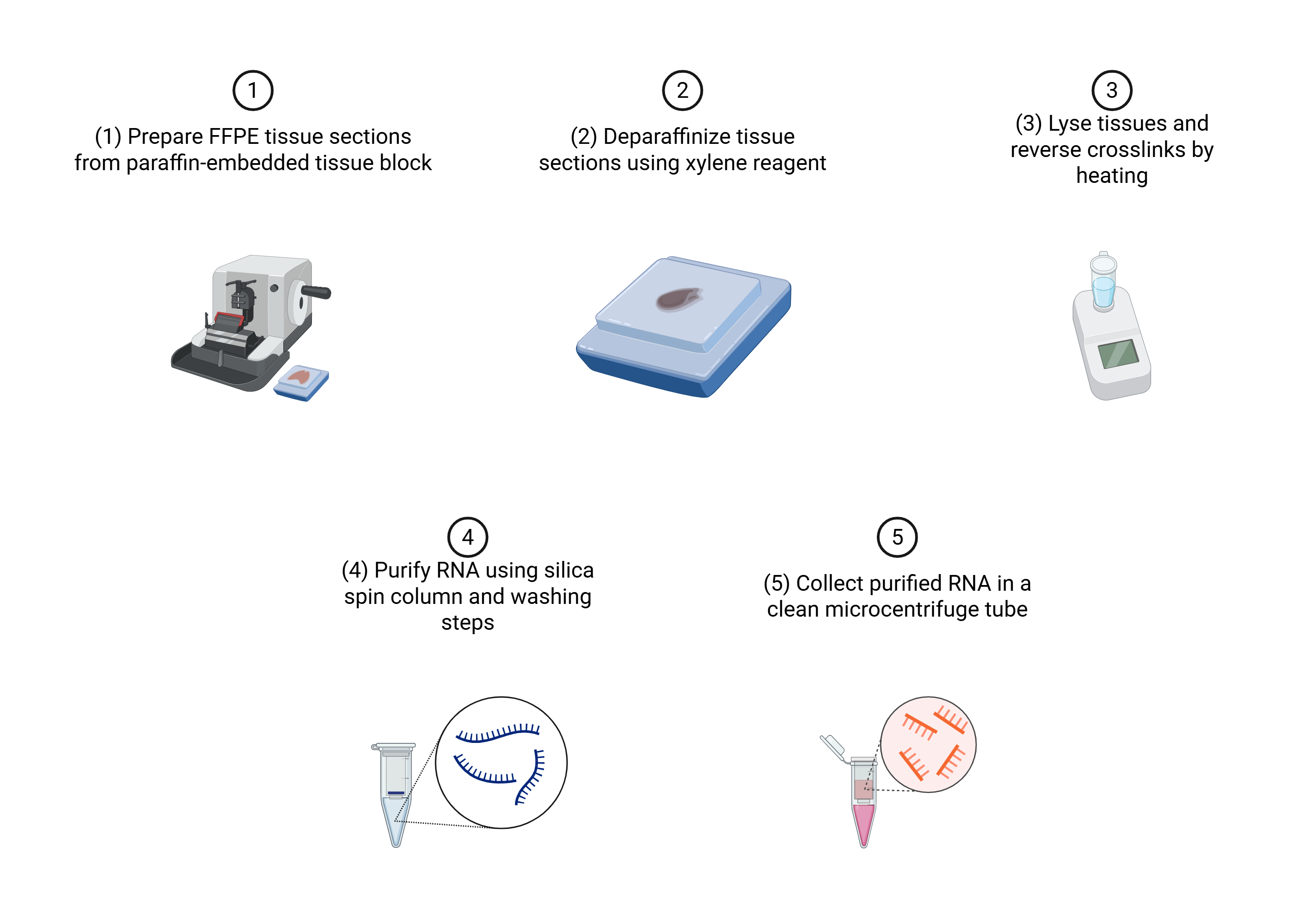
FFPE RNA Extraction Workflow
A standard FFPE RNA extraction workflow includes several critical steps.
1. Deparaffinization
Paraffin must first be removed using solvents such as xylene or specialized buffers.
2. Tissue Lysis
Lysis buffers and proteases break down tissue structures and release RNA.
3. Crosslink Reversal
Heat treatment is used to reverse formaldehyde crosslinking.
4. RNA Purification
RNA molecules are purified using silica columns or magnetic beads.
5. RNA Elution
Purified RNA is eluted in RNase-free water or buffer for downstream analysis.
Methods Used in FFPE RNA Extraction
Different technologies are used to isolate RNA from FFPE samples.
Silica Column-Based Extraction
This is the most common method for RNA purification.
Advantages:
High purity RNA
Compatible with many downstream assays
Reliable performance
Magnetic Bead-Based Extraction
Magnetic beads enable automated RNA extraction workflows.
Advantages:
High-throughput capability
Automation-friendly
Reduced manual handling
Organic Extraction
Phenol-based methods may also be used in research laboratories.
Advantages:
High RNA recovery
Suitable for specialized applications
Applications of FFPE RNA Extraction
FFPE RNA extraction is widely used in molecular research and clinical diagnostics.
Gene Expression Analysis
Extracted RNA can be analyzed to study gene expression patterns in preserved tissue samples.
Cancer Research
Archived FFPE tumor samples allow researchers to study molecular changes in diseases such as Breast cancer.
Biomarker Discovery
Scientists use FFPE samples to identify diagnostic or prognostic biomarkers.
Genomic Sequencing
RNA isolated from FFPE samples can be analyzed using sequencing technologies such as Next-Generation Sequencing.
Factors Affecting RNA Quality in FFPE Samples
Several factors influence the success of FFPE RNA extraction.
Tissue Fixation Time
Over-fixation can severely degrade RNA quality.
Storage Duration
Long-term storage may increase RNA fragmentation.
Tissue Type
Different tissues vary in RNA preservation efficiency.
Extraction Method
Advanced kits and optimized protocols significantly improve RNA recovery.
Comparison of RNA Sources
| RNA Source | RNA Quality | Stability | Common Use |
|---|---|---|---|
| Fresh tissue | Very high | Low | Molecular research |
| Frozen tissue | High | Moderate | Gene expression studies |
| FFPE tissue | Moderate | Very high | Clinical pathology |
Best Practices for Successful FFPE RNA Extraction
To obtain high-quality RNA from FFPE tissues, laboratories should follow several best practices.
Use RNase-free reagents and equipment
Optimize deparaffinization steps
Include crosslink reversal during extraction
Minimize RNA degradation during processing
These strategies significantly improve RNA yield and quality.
Future Developments in FFPE RNA Extraction
Advances in molecular biology technologies are improving FFPE RNA extraction methods.
Emerging innovations include:
Automated RNA extraction platforms
Improved enzyme formulations
Microfluidic RNA purification technologies
Integrated RNA extraction and sequencing workflows
These developments will enhance the use of archived FFPE samples in biomedical research.
Conclusion
FFPE RNA extraction plays a crucial role in modern molecular biology, allowing researchers to analyze RNA from archived tissue samples preserved in pathology laboratories. Although RNA extraction from FFPE tissues presents technical challenges, optimized protocols and specialized extraction kits enable reliable RNA isolation.
This technology continues to support critical research in cancer biology, biomarker discovery, and genomic medicine.
Recent Posts
-
SD Dengue Duo NS1 Ag and IgG/IgM Test – 25 Tests
SD Dengue Duo NS1 Ag and IgG/IgM Test – 25 Tests Product Overview The SD Dengue Duo NS1 Ag and IgG/I …25th Mar 2026 -
Neptune Barrier Tips - 20uL // Universal Fit // 10 racks of 96/pk tips each
Product Overview Neptune Barrier Tips 20 µL (Universal Fit) are high-quality, sterile filter pipette …25th Mar 2026 -
FFPE RNA Extraction
FFPE RNA Extraction: Methods, Protocols, and Applications in Molecular Biology Introduction to FFPE …16th Mar 2026